
How to weave buds, flowers and leaves of dandelion, schemes and photos of beads
In this article we will weave from beads to solarrays falling to the ground - dandelions. In the language of flowers, they mean happiness. A lot of legends, legends and myths go about this wonderful and bright flower. In one of them it is told that one day in the spring the sun was admiring the green grass on the ground. But in this splendor, something was missing. The sun shook her hand, and golden lights appeared on the ground - dandelions. But the winter, lurking nearby, did not want such warm and bright flowers. She waved her hand, and all the dandelions were covered with a thin layer of fluffy snow. Since that time, it was so, first dandelions shine bright sunlight, and then put on fluffy white fur coats. In the practice of feng shui, it is believed that the dandelion protects from unhappiness, and also brings health and prosperity to the whole family. In order that such a wonderful bright sunshine amulet appeared at your home, we suggest creating it from beads. 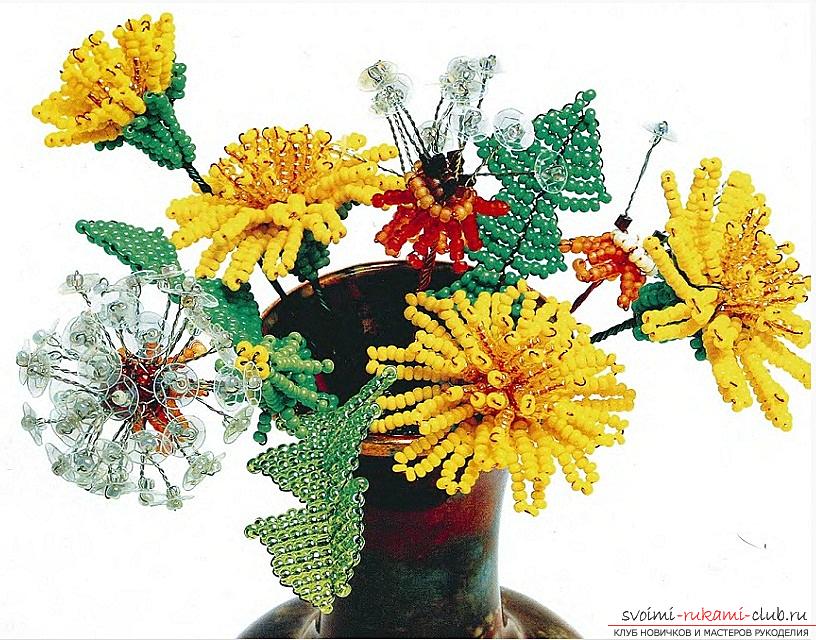 For a bouquet of dandelions you need:
- Beads 11/0 bright yellow (transparent and opaque), green (fine), brown dark (with large holes), brown light and transparent (shallow);
- Transparent round glitter approximately 40 pcs.
- The wire is thin. Green, white and yellow;
- 2 needles;
- The line;
- Thread or florent tape for winding.
In our bouquet, bringing happiness, will be andbuds, and open flowers, and fluffy white inflorescences. For weaving flowers will be used needle technique. To create leaves - parallel weaving. Buds.  We will work on a piece of wire 40 cm. String 1 yellow bead and place it in the center. Both wire tails are passed in 2 yellow beads. Now for each wire tail, thread 8 green beads. Now we need to cross the ends of the wire in the 1st green bead (we pass the tails through the hole towards each other). Procrastination tighten. On 1 of the wire tails string 3 beads of green, arrange them next to the rest. Pass the wire through the first two beads and tighten. With the second wire tail go likewise. (see Figure 1a). It will be necessary to weave three such blanks and connect them to each other in the following way: a wire tail to pass one of the details into a bead, in which both ponytails intersect, thread another 1 green bead and pass into it the tail of the second part, which also leaves the bead, in which the wire ends were crossed. (see Figure 1 b.). We take a piece of wire length of 40 cm and weave on it a needle of 3 yellow beads. With one tail wrap 3 blanks below the yellow needles (see Figure 1 in position A). We stretch the wire and twist the ends tightly. Now weave on these two wire tails green beads in the same way as the three blanks. We got 8 wire ends. They need to be strung on 3 beads of green color. Move them to the other beads denser and twist all the tails of procrastination. (see Figure 1 in position B). The bud is ready. We pass to the weaving of a flower.
 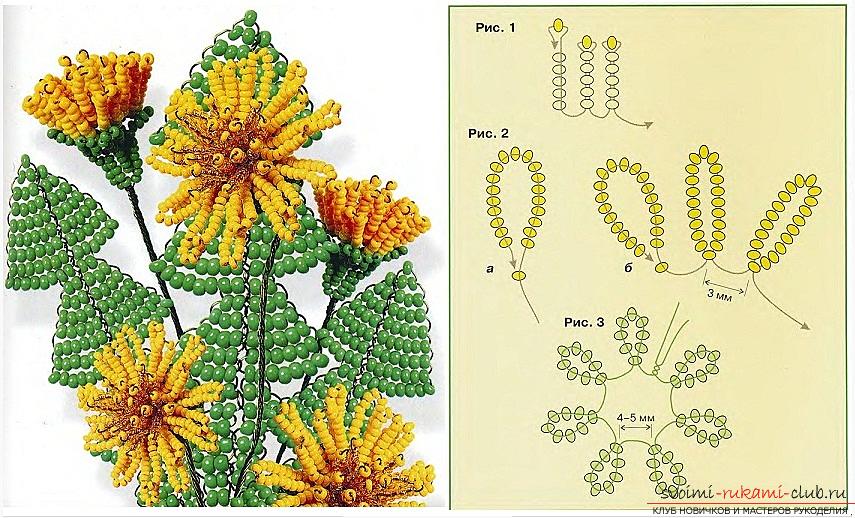 The center of the flower will be from 18 to 22 bead needles. On a piece of wire 50 cm long we sew 5 transparent yellow beads and 1 yellow opaque. We pass one of their wire tails through the transparent yellow beads by reverse motion. A spade of needles alternately on the right end of the wire, then on the left. (see Figure 1.). All the needles are collected and rolled into a cylinder. Secure with remaining wire tails. For petals around the edges we use loop technology. We will spin opaque yellow beads on pieces of yellow wire in 40 cm long. We collect about 20 beads (about 2.5 cm in length) and move them closer to one edge. Now you need to pass a longer tail in the first beaded bead in the opposite direction. (see Figure 2a). We need to weave 9 such loops. The gap between them is about 3 - 4 mm. (see Figure 2 b). We connect the loops. We twist the wire tails. Flatten the loops in length. Now it is necessary to perform 12 more large petals on a piece of wire 60 cm in length. For each eyelet, you will need 23 beads (about 3 cm). Now plaited sepals with green beads. A piece of wire 45 cm long is sewn 8 beads and is centered. Plait the loop as above. You need to make 3 more loops at each end of the wire. The distance between the loops is about 4 - 5 mm. The ends of the wire twist. (see Figure 3.). Now we collect the needle-shaped core, then small and large petals and at the end of the lower part of the sepals. All the wire tails tightly twisted into one. In addition to sepals. Leave approximately 1 cm of flagellum. The rest we cut off. The stem is made of four green wires 30 cm long. They are folded in half. And we have between 2 - 3 petals (ie, the wires seem to hang on them) along the perimeter of the flower. Press these wires, pulling, to the bottom of the dandelion. We got 10 tails (2 from the sepals and 8 from the last procrastination). They need to be strung on 7 beads of green color. We move the beads tightly to the flower and tightly twist the wire ends. When the flowers and buds are ready, we proceed to the leaves.
 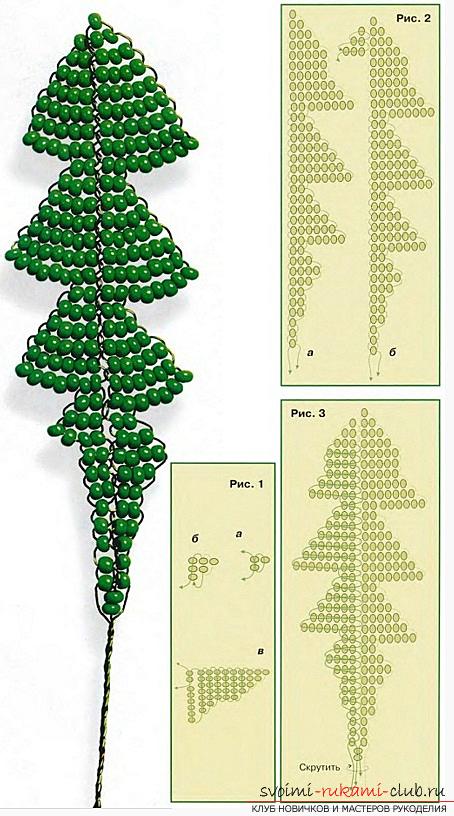 We will spin parallel machinery in two parts. On a piece of wire about 60 - 65 cm, we collect 3 beads. We arrange them in the center. Then one tail of the wire is passed through the last two beads to meet the other. (see Figure 1a). Cross the wire tails in three typed beads. (see Figure 1 b.). Now it needs to be tightened. Scourge by following the picture. Row, in which 8 beads, we do as follows: on one pony string 8 beads, and the second tail is passed only through the two beads, located closest. (see Figure 1 c.). Make sure that one side of the workpiece is flat. (see Figure 2a). Now we shave from the second piece of wire 60 - 65 cm long, the second half of the leaf. We pass the wire between the rows of two and three beads. We string 3 beads and cross the wire tails in the last two beads. The wire tail, located closer to the first half of the leaf, must be threaded into the next wire shackle between the rows of three and four beads. Tighten the wire more tightly. On one ponytail to string 3 beads and pass a second tail in them. (see Figure 2 b). Continue weaving, as shown in Figure 3. When the leaf is finished, on 2 wire tails, which are located in the middle, you need to thread 2 beads and twist all the wire ends together. Now left to weave a fluffy white dandelion.
 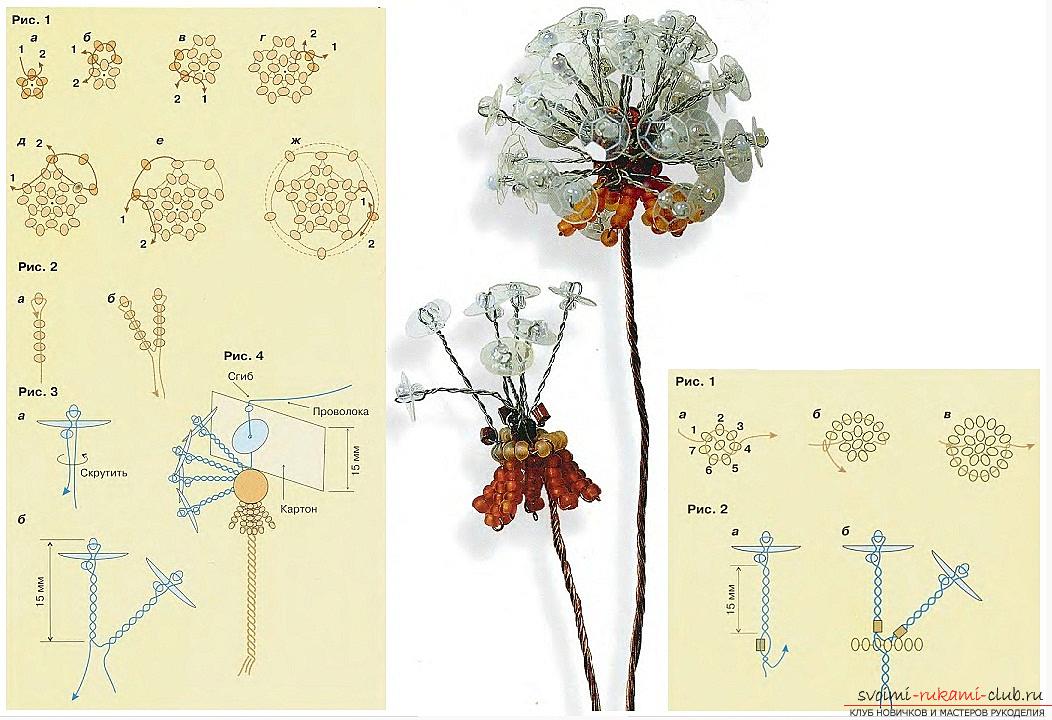 The core of a fluffy dandelion will be in the form ofa bead, woven with beads of a dark brown hue. Now you need to take a piece of fishing line and put it in needles at both ends. In the middle of the line, it is necessary to make a ring of 5 beads, having crossed the needles with a fishing line in the first bead. (see Figure 1 a. top). On the diagrams, this ring is indicated by a large dot. Around this ringlet weave a row of 5 cells of 5 beads each. 1st row of cells:
- 1st cell. On the needle number 1 we put on a bead. On the needle number 2 string 3 beads and pass this needle through a bead on the needle No. 1 and the nearest bead of the initial ringlet. (see Figure 1 b. beads, which we added at this stage, are highlighted more clearly). Tighten the line.
- 2nd cell. On the needle No. 2 we sew 1 bead, on needle 1 we string 2 beads. We pass No. 1 through a bead on the needle No. 2 and beads of the initial ringlet. (see Figure 1 c.).
- 3rd and 4th plait is similar.
- 5th cell. Needle No. 1 is to be threaded into the nearest bead of the 1st cell, thread 2 beads on the needle No. 2 and thread the needle No. 1 through the 2nd bead. (see Figure 1)
2nd row of cells:
- 1st cell. Needle No. 2 pass through the nearest neighbor bead of the next cell of the 1st row and thread on it 1 bead. On the needle number 1 string 2 beads. Now we pass needle No. 1 through a bead on needle No. 2 and through 2 beads of the first row from different cells. (see Figure 1, d).
- 2nd cell. On the needle number 1 and number 2 string on 1 bead. Now you need to pass the needle number 2 through a bead on the needle No. 1 and 2 beads of the 1st row. (see Figure 1 e).
- 3rd and 4th plait is similar. The string should be tightened more tightly, the ball should be hard.
- 5th cell. Weave according to Figure 1 g. The tails of the fishing line are tightened, fixed and cut. Leave the tail about 5 cm.
We make sepals. We use for weaving figures 2 a. and 2 b. We will be light brown beads in the sepals. Still need 5 pieces of yellow wire 40 cm long. At each turn out for 2 pieces. Through the beads of one cell we pass through one wire tail of each sepals. They need to be moved as close to the core ball as possible. All wire tails are twisted tight. We got a stem. Take a piece of white wire about 40 cm in length and strung a transparent bead. Both ponytails pass through the sequin. If you are caught convex, then you need to pass the concave side upward. On one wire tail thread 1 transparent bead. Now we move it to the sparkle and make a 1.5 cm downward twist. (see Figure 3a). Make another such umbrella (see Figure 3 b.). Now you need to thread the wire tails into beads and tighten the ball tightly. Weave more umbrellas, tightening them on the ball. It is important that they all be the same size. To do this, you can use a piece of strong cardboard with a width of 1.5 cm. Each time, tightening the wire tails, apply it for accuracy. (see Figure 4). One dandelion will need about 40 umbrellas. When all buds, flowers and leaves are ready, it is necessary to wrap the flora with a ribbon of stalk. A bouquet of dandelions is ready and can decorate a house.
Comments
Related posts:
 Detailed schemes of weaving exotic animals from beads, photos of finished products.
 How to weave lilac from beads, free detailed scheme and description, photo of the finished product
 How to weave a bead flower alstroemeria ("Peruvian lily"), a scheme, a description and a photo of the work
 How to weave a flower of narcissus from beads two variants in different techniques of weaving, diagrams, photos and description
 Bonsai from beads with own hands, how to weavetree of beads, schemes of weaving of trees from beads, birch from beads with their own hands, herringbone-souvenir from beads, creation of albition from beads, advice and recommendations on performance of works.